
LaBrowser
Instrument real web behavior
See what participants actually do.
A dedicated research browser that captures participant browsing behavior as structured data — and, when the study calls for it, lets you apply controlled changes to the live pages participants see. Participants browse naturally. You see the full picture.
Bring a study design or a feasibility question — we'll map whether LaBrowser can support it, what needs configuration, and where the limits are.
Decision making
Participants research a product or topic — across search engines, review sites, forums, Wikipedia — then make a choice in your experiment.
You see what they chose, but not which sources they found, how they compared options, how they refined their queries, or what they ignored.
AI interaction
Participants use AI assistants alongside search engines. When do they turn to AI vs. Google? How do they phrase prompts? Do they verify answers — click links, cross-check — or trust the AI fully?
The prompting behavior, the switching, the verification habits — all invisible to you.
Usability
Participants complete a task on a website. How many clicks before they reach the goal? Do they use search or navigate menus? Where do they get stuck and backtrack?
You see whether they finished, but not the navigation path, the dead ends, or the hesitations.
So researchers fall back on screen recordings, browser extensions, and think-aloud protocols. They either miss the behavior, blur the privacy boundary, or leave you coding video by hand.
The browser is the one place where the behavior is already visible. LaBrowser makes it measurable.
How behavioral studies run in LaBrowser
Define your study
Set allowed domains, capture rules, and start URL in the Study Console. Add an experiment pane for instructions.
Participants browse
They use LaBrowser instead of their normal browser. Everything inside is logged. Everything outside is untouched.
Analyze structured data
Every navigation, click, search query, and chat prompt — captured as typed, timestamped events. Export or explore in the Console.
Try it yourself
Don't take our word for it.
Let us instrument you.
Do a 60-second task in a fully simulated mini-web — a fake Google, a fake AI assistant. Then we flip the panel and reconstruct your own browsing as the exact structured data LaBrowser captures from real participants.
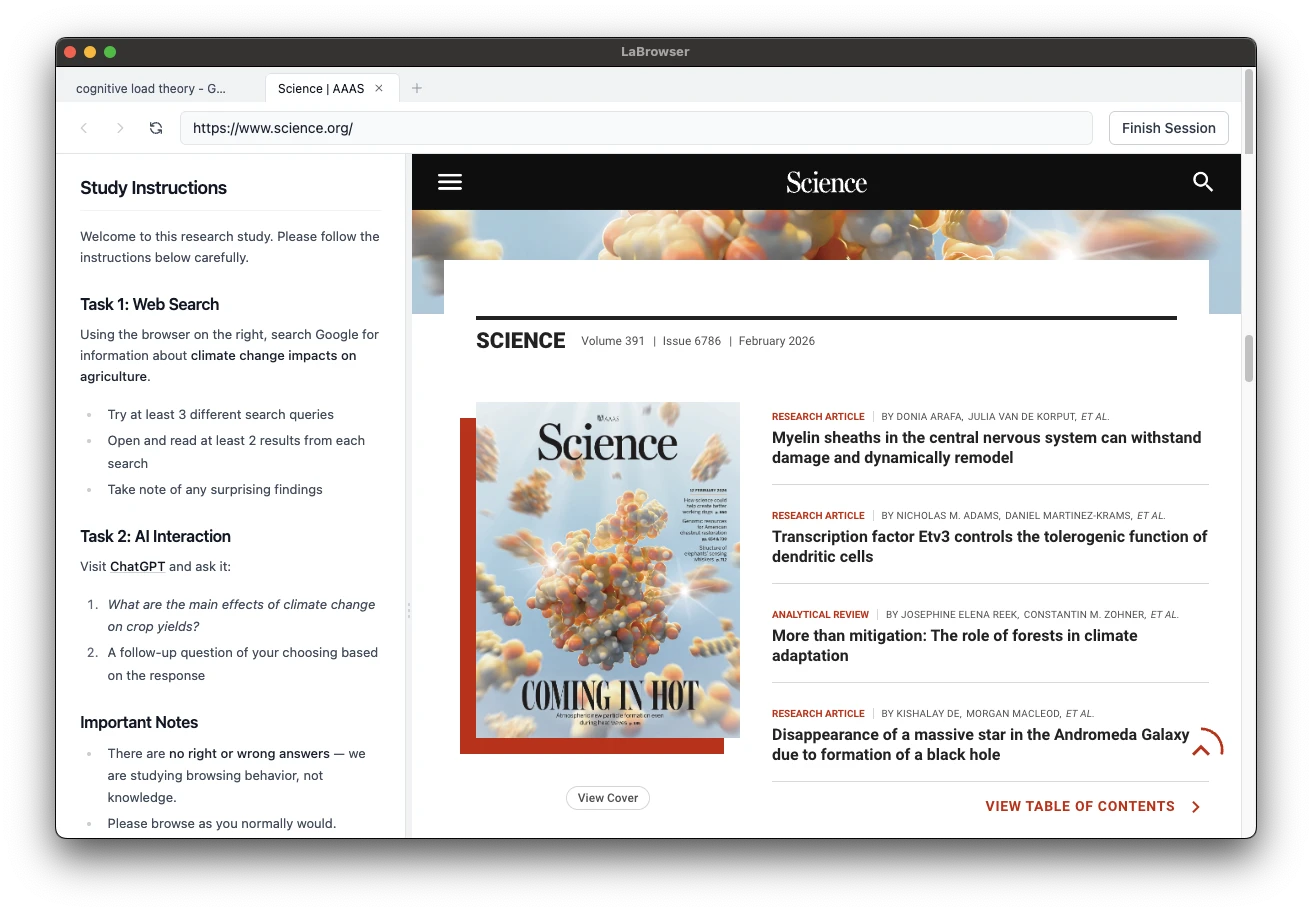
Participant browses in LaBrowser
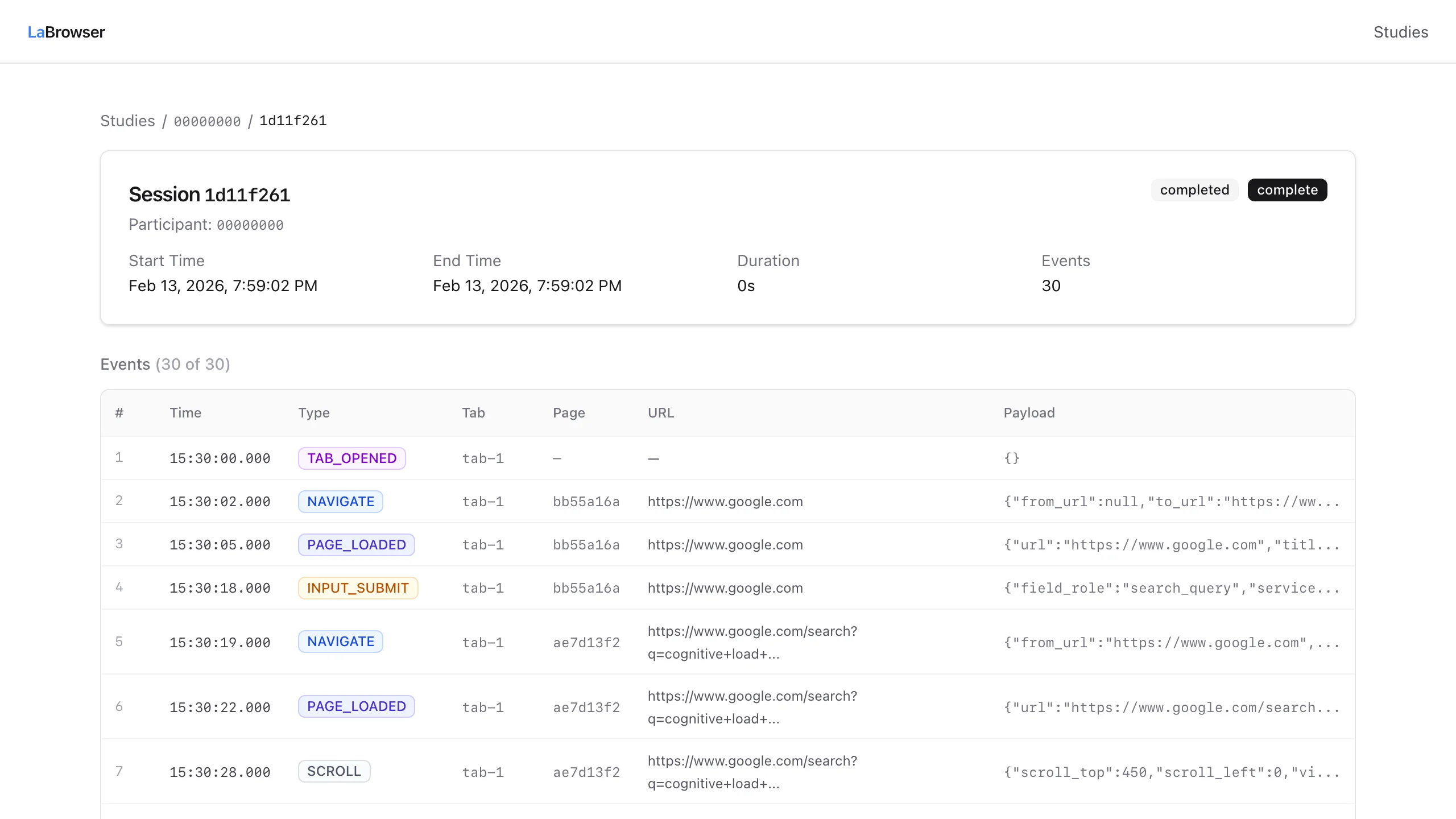
Researcher sees structured event data
Click to enlarge
Site augmentation
Not just observation.
Controlled intervention.
Most web research tools can only watch what happened. LaBrowser can also
change the study environment
— hide distracting elements, label recommendation modules, suppress variants, or compare conditions on the real, live website.
So you study behavior in the actual context where decisions happen, without building a fake clone of the web.
Recommended for you
Recommendation shelf — removed for this condition
Hide or label elements
Remove recommendation shelves, mark promoted modules, or annotate interface regions.
Conditions on live sites
Compare control vs. treatment experiences without rebuilding the website.
Output stays analyzable
Every augmentation is tied to structured event data, so analysis knows exactly what the participant saw.
Built for web behavior research
Full event capture
Navigation, clicks, scrolls, search queries, chat prompts. Not limited by extension APIs.
Domain enforcement
Whitelist exactly which sites participants can visit. No distractions, no data leakage.
Experiment pane
Show instructions or custom experimental UI alongside the browsing pane.
Structured parsers
Auto-detect Google search sessions and ChatGPT conversations. Build custom parsers for any site.
Recovery-aware sessions
Data is stored locally first, resumes syncing after interruptions, and supports recovery if a session is interrupted.
Privacy boundary
Everything in LaBrowser is logged. Your normal browser is not. Email addresses are automatically anonymized before data is stored.
Learn the workflow
Understand how researchers configure, launch, and review behavioral studies in LaBrowser.
See structured outputs
Review how event capture and parsers turn browsing sessions into analyzable data.
Browse example studies
See search behavior, product decisions, and structured outputs from public example studies.